
From Oxidation to Opportunity: Precision Molecular Filtration Saves Hawke’s Bay Wine
Authors:
Dr. Aaron Low - Chief Technical Officer, amaea
Dr. Sylvia Baars - Head of Science, amaea
Jason Stent - Winemaker, Paritua Wines
Introduction
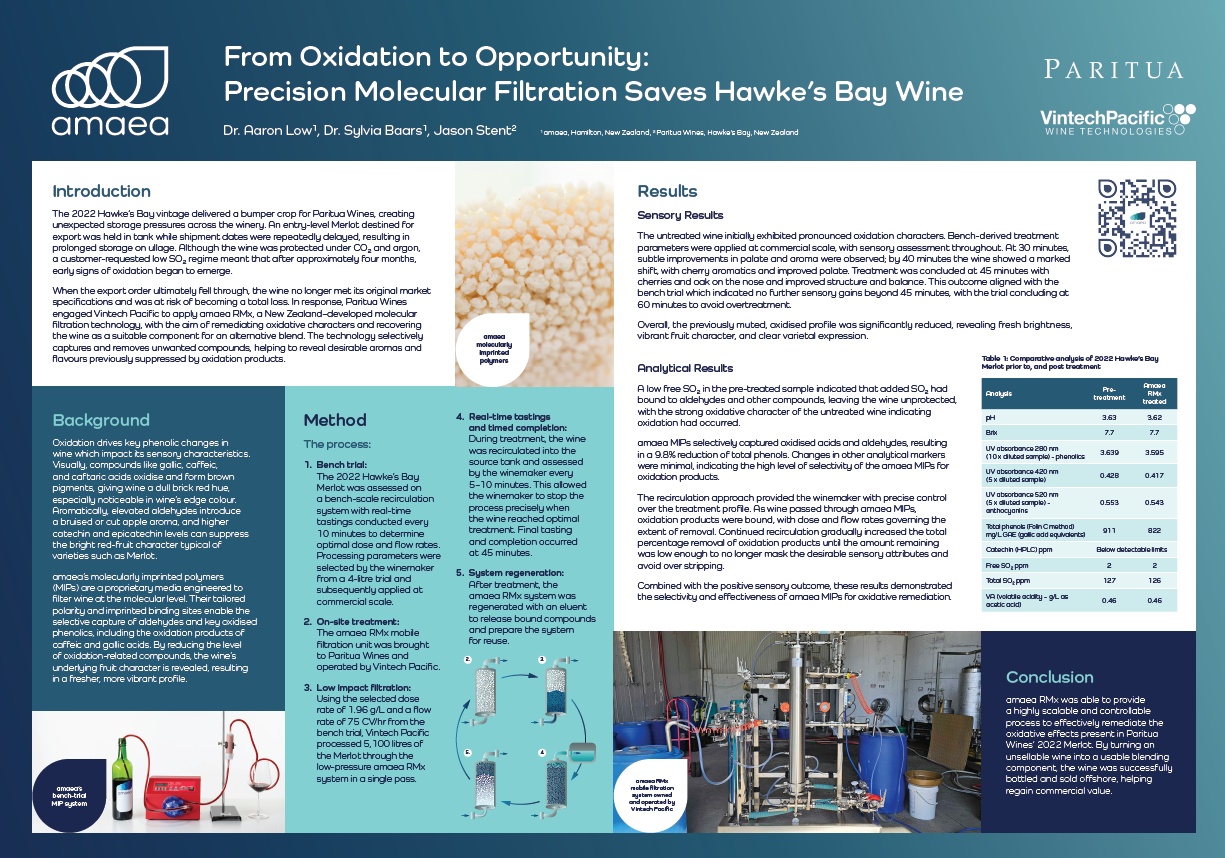
The 2022 Hawke’s Bay vintage delivered a bumper crop for Paritua Wines, creating unexpected storage pressures across the winery. An entry-level Merlot destined for export was held in tank while shipment dates were repeatedly delayed, resulting in prolonged storage on ullage. Although the wine was protected under CO₂ and argon, a customer-requested low SO₂ regime meant that after approximately four months, early signs of oxidation began to emerge.
When the export order ultimately fell through, the wine no longer met its original market specifications and was at risk of becoming a total loss. In response, Paritua Wines engaged Vintech Pacific to apply amaea RMx, a New Zealand–developed molecular filtration technology, with the aim of remediating oxidative characters and recovering the wine as a suitable component for an alternative blend. The technology selectively captures and removes unwanted compounds, helping to reveal desirable aromas and flavors previously suppressed by oxidation products.
"By removing the oxidized, muted notes from our previously unsellable Merlot, amaea RMx revealed fresh fruit and turned it into a blend-ready, marketable wine."
Jason Stent, Winemaker, Paritua Wines
Background
Oxidation drives key phenolic changes in wine which impact its sensory characteristics. Visually, compounds like gallic, caffeic, and caftaric acids oxidize and form brown pigments, giving wine a dull brick red hue, especially noticeable in wine’s edge color. Aromatically, elevated aldehydes introduce a bruised or cut apple aroma, and higher catechin and epicatechin levels can suppress the bright red-fruit character typical of varieties such as Merlot.
amaea’s molecularly imprinted polymers (MIPs) are a proprietary media engineered to filter wine at the molecular level. Their tailored polarity and imprinted binding sites enable the selective capture of aldehydes and key oxidized phenolics, including the oxidation products of caffeic and gallic acids. By reducing the level of oxidation-related compounds, the wine’s underlying fruit character is revealed, resulting in a fresher, more vibrant profile.
Method
The process:
Bench trial: The 2022 Hawke’s Bay Merlot was assessed on a bench-scale recirculation system with real-time tastings conducted every 10 minutes to determine optimal dose and flow rates. Processing parameters were selected by the winemaker from a 4-litre trial and subsequently applied at commercial scale.
On-site treatment: The amaea RMx mobile filtration unit was brought to Paritua Wines and operated by Vintech Pacific.
Low impact filtration: Using the selected dose rate of 1.96 g/L and a flow rate of 75 CV/hr from the bench trial, Vintech Pacific processed 5,100 litres of the Merlot through the low-pressure amaea RMx system in a single pass.
Real-time tastings and timed completion: During treatment, the wine was recirculated into the source tank and assessed by the winemaker every 5–10 minutes. This allowed the winemaker to stop the process precisely when the wine reached optimal treatment. Final tasting and completion occurred at 45 minutes.
System regeneration: After treatment, the amaea RMx system was regenerated with an eluent to release bound compounds and prepare the system for reuse.
Results
Sensory Results
The untreated wine initially exhibited pronounced oxidation characters. Bench-derived treatment parameters were applied at commercial scale, with sensory assessment throughout. At 30 minutes, subtle improvements in palate and aroma were observed; by 40 minutes the wine showed a marked shift, with cherry aromatics and improved palate. Treatment was concluded at 45 minutes with cherries and oak on the nose and improved structure and balance. This outcome aligned with the bench trial which indicated no further sensory gains beyond 45 minutes, with the trial concluding at 60 minutes to avoid overtreatment.
Overall, the previously muted, oxidized profile was significantly reduced, revealing fresh brightness, vibrant fruit character, and clear varietal expression.
Analytical Results
A low free SO₂ in the pre-treated sample indicated that added SO₂ had bound to aldehydes and other compounds, leaving the wine unprotected, with the strong oxidative character of the untreated wine indicating oxidation had occurred.
amaea MIPs selectively captured oxidized acids and aldehydes, resulting in a 9.8% reduction of total phenols. Changes in other analytical markers were minimal, indicating the high level of selectivity of the amaea MIPs for oxidation products.
The recirculation approach provided the winemaker with precise control over the treatment profile. As wine passed through amaea MIPs, oxidation products were bound, with dose and flow rates governing the extent of removal. Continued recirculation gradually increased the total percentage removal of oxidation products until the amount remaining was low enough to no longer mask the desirable sensory attributes and avoid over stripping.
Combined with the positive sensory outcome, these results demonstrated the selectivity and effectiveness of amaea MIPs for oxidative remediation.
Table 1: Comparative analysis of 2022 Hawkes Bay Merlot prior to, and post treatment
| Analysis | Pre-treatment | amaea RMx Treated |
|---|---|---|
| pH | 3.63 | 3.62 |
| Brix | 7.7 | 7.7 |
| UV absorbance 280 nm (10× diluted) – phenolics | 3.639 | 3.595 |
| UV absorbance 420 nm (5× diluted) | 0.428 | 0.417 |
| UV absorbance 520 nm (5× diluted) – anthocyanins | 0.553 | 0.543 |
| Total phenols (Folin C) mg/L GAE | 911 | 822 |
| Catechin (HPLC) ppm | Below detectable limits | Below detectable limits |
| Free SO₂ (ppm) | 2 | 2 |
| Total SO₂ (ppm) | 127 | 126 |
| Volatile acidity (g/L as acetic acid) | 0.46 | 0.46 |
Conclusion
amaea RMx was able to provide a highly scalable and controllable process to effectively remediate the oxidative effects present in Paritua Wines’ 2022 Merlot. By turning an unsellable wine into a usable blending component, the wine was successfully bottled and sold offshore, helping regain commercial value.
About amaea RMx
amaea RMx is an innovative molecular filtration solution designed to selectively target the removal of compounds responsible for off-aromas in wine. Working with the winemaker, preferred treatment rates are determined to reduce impacts and bring forward the desirable characters of the wine.